



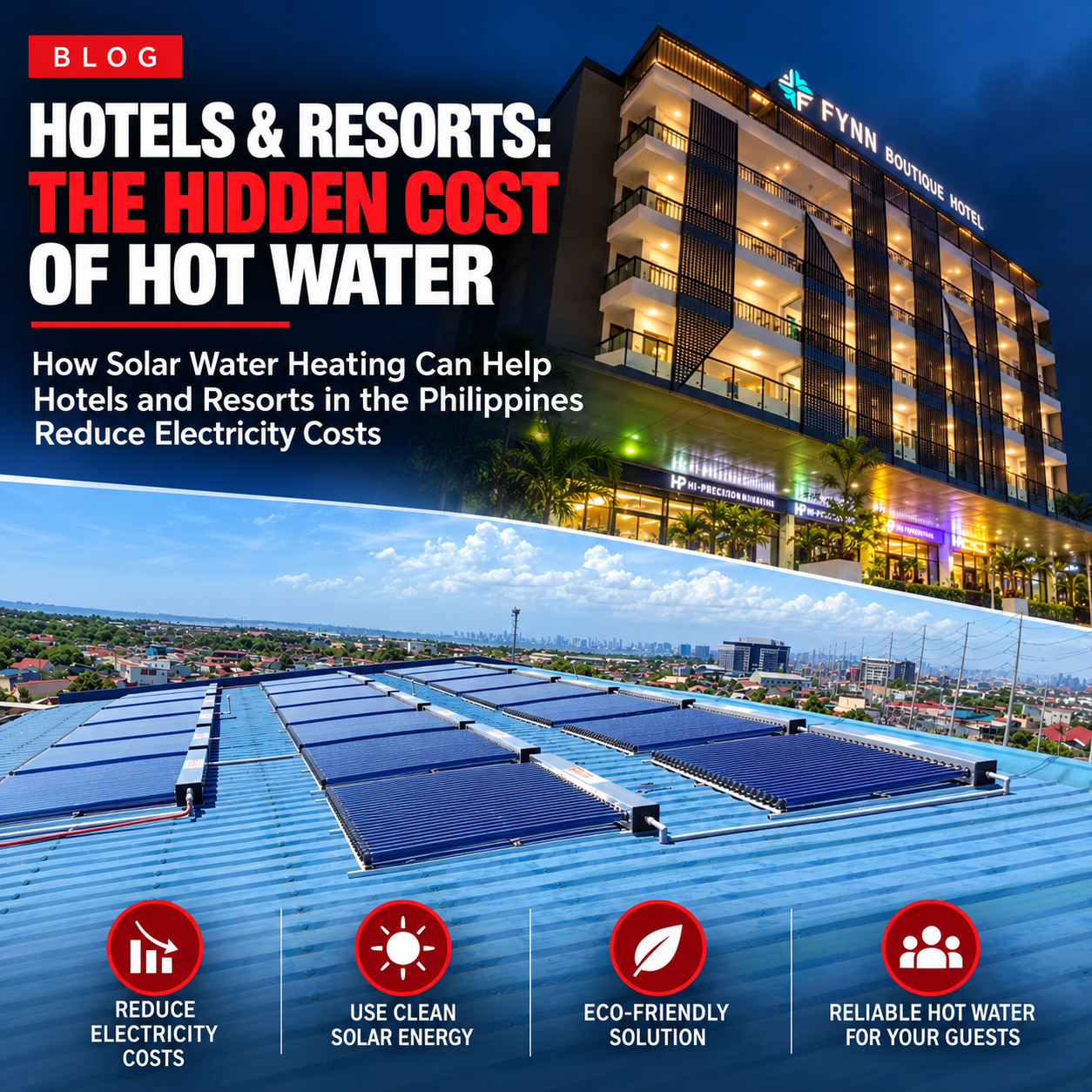
How Solar Water Heating Can Help Hotels and Resorts in the Philippines Reduce Electricity Costs
Your guests enjoy the hot showers. But have you ever considered how much energy it takes to heat the water?
Every hotel and resort owner knows that air conditioning is a major electricity expense.
But there is another energy expense that often goes unnoticed.
Water heating.
Whether it’s a guest enjoying a warm shower after a long day, a family returning from the swimming pool, or someone relaxing in a bathtub, hot water is an essential part of hospitality.
And behind every hot shower is energy being consumed.
For hotels and resorts in the Philippines, solar water heating offers an opportunity to reduce recurring electricity expenses by using the country’s abundant sunshine to heat water.
- One Electric Water Heater Can Consume as Much Power as Four Flat Irons
Imagine turning on four electric flat irons at the same time.
That’s approximately the electricity demand of a single 4,000-watt electric shower heater, compared with four 1,000-watt flat irons operating at full power.
Now imagine several guest rooms using their electric heaters simultaneously.
Five showers could mean an electrical load of 20,000 watts, or 20 kilowatts, when all five 4,000-watt heaters are operating at full power.
That’s equivalent to 20 flat irons operating simultaneously.
And across a busy hotel or resort, hot-water demand can occur repeatedly throughout the day.
The important distinction is that electricity cost depends on how much power is used and for how long. A 4,000-watt heater running at full power for 15 minutes consumes approximately 1 kilowatt-hour of electricity.
Unlike air conditioning, where energy use is frequently discussed, the cost of water heating can remain hidden within an establishment’s overall electricity bill.
- Hotel and Resort Guests Use Hot Water Differently
At home, many people take quick showers before leaving for work.
But in hotels and resorts, bathing habits can be very different.
Resort guests may shower in the morning, enjoy the swimming pool during the day, and take another warm shower in the evening.
Some guests enjoy longer showers simply because they are on vacation.
Others use bathtubs, bathroom lavatories, and additional hot-water facilities.
Hotels have their own consumption patterns. Business travelers may shower before meetings and again after returning in the evening. Families may use multiple bathrooms or bathtubs.
The more guests you accommodate, the greater your potential hot-water demand.
And when that water is heated electrically, the energy expense continues.
- The Hidden Operating Expense That Keeps Repeating
Hotel and resort owners regularly evaluate expenses such as staffing, maintenance, laundry, electricity, and air conditioning.
But how often do they examine the actual cost of heating water?
Electric water heaters may be relatively inexpensive to purchase.
However, every time they operate, they consume electricity.
Multiply that by the number of occupied rooms, the number of guests, and the number of showers taken every day.
Then consider the accumulated expense over five, ten, or fifteen years.
The real cost of a water heater is not just the price of the equipment. It is also the energy you keep paying for throughout its lifetime.
This is why hotels and resorts should evaluate the total cost of water heating, including equipment, electricity, maintenance, and long-term operating expenses.
- Why Keep Paying to Heat Water When the Sun Can Do the Work?
The Philippines enjoys abundant sunlight throughout the year.
That sunlight contains thermal energy that can be captured and used to heat water.
Solar water heating systems use solar collectors to capture the sun’s thermal energy and transfer it to water, which can then be stored in an insulated tank for later use.
ThermoTank Solar Water Heating Systems are designed to help homes and commercial establishments reduce dependence on conventional electric water heating.
Instead of relying entirely on electric heaters, hotels and resorts can use solar-heated water for guest bathrooms and other suitable hot-water applications.
Properly designed systems can also incorporate backup heating to maintain reliable hot-water service when sunlight is insufficient.
Solar water heating does not eliminate every operating expense. However, it can significantly reduce the amount of purchased energy needed to heat water, depending on system design, usage patterns, and sunlight availability.
The sun provides the energy. ThermoTank helps put it to work.
- A Smarter Investment for Hotels and Resorts
When investing in hotel equipment, the lowest purchase price does not always mean the lowest long-term cost.
A conventional electric heater may appear economical initially, but its energy consumption becomes a recurring operating expense.
Solar water heating requires an initial investment, but it can reduce purchased energy for hot water over many years.
For establishments with consistent daily hot-water demand, the accumulated savings can be significant.
The opportunity is not limited to large hotels.
Boutique hotels, beach resorts, family resorts, private villas, and other hospitality establishments in the Philippines can all evaluate the potential benefits of solar water heating.
The appropriate system depends on several factors, including:
- Number of guest rooms and expected occupancy
- Daily hot-water consumption and peak demand
- Existing electric or fuel-based water heating equipment
- Available roof space and sunlight exposure
- Storage capacity and backup heating requirements
With proper sizing and system design, solar water heating can become part of a hotel’s long-term energy management strategy.
- Let Your Guests Enjoy the Hot Water. Let Your Business Enjoy the Savings.
Hot water is part of the comfort your guests expect.
You shouldn’t have to compromise that comfort just to control electricity expenses.
With ThermoTank, you can explore a more energy-efficient way to provide hot water while reducing dependence on conventional heating.
Because in the hospitality business, smart investments are not only about attracting more guests.
They’re also about reducing the cost of serving every guest.
Frequently Asked Questions About Solar Water Heating for Hotels and Resorts
Can solar water heaters supply hot water to hotels and resorts?
Yes. Solar water heating systems can be designed for commercial establishments, including hotels, resorts, and guest accommodations. The required capacity depends on the number of guests, daily consumption, and peak hot-water demand.
Do solar water heaters work during cloudy or rainy weather?
Solar water heaters can still collect some solar energy under cloudy conditions, but performance is reduced. Backup electric or other auxiliary heating can provide additional heat when needed to maintain reliable guest service.
Can solar water heating reduce hotel electricity bills?
Yes. When solar heating replaces part of the energy previously supplied by electric water heaters, electricity consumption can decrease. Actual savings depend on the existing heating system, electricity rates, water usage, local solar conditions, and system design.
Are solar water heaters suitable for small resorts and boutique hotels?
Yes. Smaller establishments can evaluate appropriately sized systems instead of installing a system intended for a large commercial property. The right solution depends on actual hot-water demand and the building’s plumbing layout.
How do I know what size solar water heater my hotel needs?
System sizing should consider the number of occupied rooms, guests per room, hot-water consumption, peak simultaneous demand, desired water temperature, and available solar collection area. A proper assessment helps prevent undersizing and unnecessary investment.
Discover the Potential Savings for Your Hotel or Resort
Every hotel has different hot-water requirements.
Before choosing a system, it helps to understand how much hot water your establishment consumes and how much energy you currently spend heating it.
ThermoTank Solar Water Heating Systems
Explore how solar water heating can help reduce your hotel’s or resort’s operating expenses.
Thermo Tank — Free Hot Water for Life.
Free energy from the sun. Less purchased energy for water heating. Long-term savings.
Actual savings depend on system design, operating conditions, maintenance, and the proportion of hot-water demand met by solar energy.
